Teaching is complex.
At any given moment, teachers are managing content, lesson structure, and live instruction. At the same time, they are responding to students in real time and ensuring that delicate balance between too much and too little cognitive load. The challenge is not doing more, but doing specific things well, based on what we know about how learning actually happens, without overwhelming working memory.
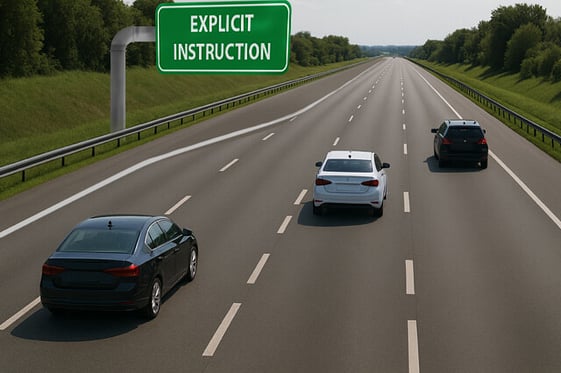
One way to make this complexity more manageable is to think about teaching as a three-lane highway. This helps us compartmentalise our focus and reflect on where instruction is flowing well and where it is starting to slow. Our job as teachers is to keep the traffic moving. That means no jams where learning comes to a complete halt, no bottlenecks where we overload students into cognitive overdrive, and no pile-ups that slow learning to a crawl.
The On-Ramp: Active Participation and Opportunities to Respond
Before traffic can flow smoothly, there needs to be a clear, well-managed entry point — an on-ramp. In the classroom, that on-ramp is explicit instruction — brought to life through students’ active participation and frequent opportunities to respond. During explicit instruction, expectations for learning are established and reinforced and students learn that:
Everybody does everything during whole-class instruction
Participation is expected, not optional
Participation is safe, supported, routine and equitable for all learners
Partners are an instructional tool, not a social extra
From a Science of Instruction perspective, active participation matters because learning requires active cognitive engagement. Students do not learn effectively by watching others think. Well-designed opportunities to respond ensure all students are processing content in working memory, which is essential for building long-term memory.
When this on-ramp is strong, students enter lessons knowing exactly what is expected of them. That clarity sets the conditions for everything that follows.
The short video below shows this on-ramp in action during a reading lesson. Notice how explicit instruction, partner work, and high rates of participation work together to keep learning moving, with no congestion and no students left idle.
Lane 1: Learn the Content - Build Your Knowledge
The first lane is content knowledge. This lane represents how well we know what we are teaching and not just at a surface level, but well enough to explain it clearly, model it accurately, and respond to misconceptions as they arise.
Whether it is spelling, reading, writing, mathematics, or subject knowledge within a unit, content fluency matters. When teachers know the road ahead, instruction is smoother and more confident. When content knowledge is shaky, lessons slow down, explanations lose precision, and students sense the uncertainty.
The Science of Learning is clear that learning involves building organised knowledge in long-term memory or schemas. Teachers who understand the content deeply are better positioned to support students to build coherent schemas efficiently.
Furthermore, this lane is often an area for ongoing development. Strengthening it might involve revisiting curriculum progressions, unpacking key concepts, or ensuring your understanding is strong enough to support high-quality instruction across the lesson.
Lane 2: Lesson Design and Automaticity - Preventing Bottlenecks
The second lane is lesson design and sequencing. Effective lessons are deliberately structured. They include an opening, a body, and a closing, and over time this should become automatic.
The opening is particularly important. Before you begin ask yourself:
Do I have their attention?
What are they thinking about?
Am I prepared for the practice ahead?
Retrieval practice is one of the most effective ways to strengthen learning. Beginning lessons with purposeful review helps students retrieve prior knowledge, strengthens memory, and prepares them for new learning.
When lesson sequences are not automatic, bottlenecks appear. Teachers are managing too many decisions at once, cognitive load increases for both teachers and students, and instructional flow suffers.
When lesson design is automatic, learning flows. Teachers are freed up to focus on students, monitor understanding, and adjust instruction without losing momentum.
Lane 3: Delivery - Keeping Learning Moving in Real Time
The third lane is delivery. This is where content knowledge and lesson design come together in live instruction. It includes clarity of explanations, modelling, pacing, checking for understanding, feedback, and responsiveness.
This lane is the most visible — and the most vulnerable. If content knowledge or lesson structure is underdeveloped, delivery is where the impact is felt first. Opportunities to respond decrease, participation narrows, and learning slows.
As Anita Archer, a leading expert in explicit instruction, consistently reminds us, delivery is what really matters. It is where evidence-based design becomes lived classroom practice.
Keeping the Highway Flowing
These three lanes are not a set of boxes to tick. They are a way of thinking about instruction and deciding where next to place your professional focus. Use these questions to guide your focus:
Have I established expectations for learning?
Do I know the content?
Is my lesson designed with a clear opening, body and closing and have I planned for review and retrieval?
Is my delivery responsive, full of opportunities to respond and rich with active participation? Does it feel like a tennis match?
At different points in the year, you may choose to work deliberately on different lanes. What matters is recognising that in structured literacy, structured maths and knowledge-rich curriculum units, all three are in motion all the time. Keeping the teaching highway flowing means noticing where congestion is building and addressing it intentionally.
If strengthening explicit instruction, lesson design, and delivery is a focus for you or your school, we would love to support you. Our two-day Effective and Efficient Instruction training is designed to help educators embed explicit instruction for consistent, school wide practice.
Let's ensure learning flows for every student.