
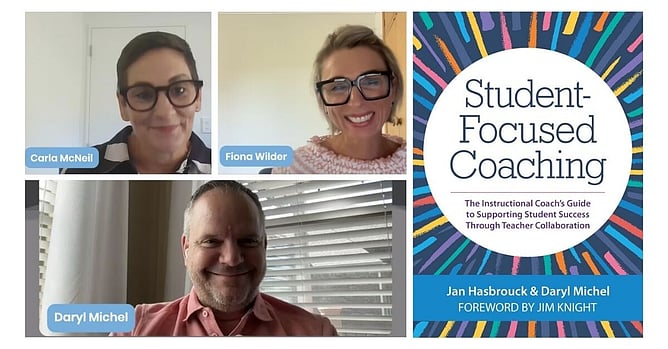
Reflections from a recent Chit Chat with Daryl Michel, Fiona Wilder, and Carla McNeil
Right across Aotearoa New Zealand, educators are being asked to implement significant change.
A refreshed curriculum.
A stronger emphasis on evidence informed instruction.
Structured approaches to literacy and mathematics.
Tighter alignment between teaching and assessment.
And here is what we know. Professional learning in isolation is not the ticket.
Schools make the greatest progress when they have strong coaching structures that help teachers translate learning into sustained classroom practice. Coaching is not an add on. It is the lever that underpins implementation, improvement, progress monitoring, and long term sustainability.
This is why a Chit Chat with Daryl Michel is so critical right now.
Carla, myself and our leadership team have been working alongside Daryl in a very deliberate way. We have read the book, completed online modules, and are now in live online sessions with Daryl where we revisit key ideas, then go away and complete assignments that force us to apply the learning in real contexts.
And I will be honest. This work has broadened my perspective on what coaching actually is.
Below are five threads from our conversation that I think matter for anyone leading change in schools.
1. Coaching is not a title. It is a responsibility we share.
Daryl named something I see often.
In many systems, one person is hired, given the title coach, and suddenly they are expected to be the knower of everything. Curriculum, assessment, instruction, change. It is unrealistic, and it is not sustainable.
A coach can be anyone. And in many ways, a coach should be everyone.
Teachers coach students every day. Leaders coach teams. Colleagues coach one another. The question is not, “Do we have a coach?” The question is, “Do we have a coaching culture?”
When coaching sits with one person, it disappears the moment funding changes or that person moves on. When coaching is built across the school, capability stays.
2. Data gives perspective. It must drive the actions we take.
This work keeps looping back to one central idea. Start with what the data says.
Not what we believe.
Not what we prefer.
Not what we have always done.
Daryl talked about the importance of using multiple sources of data and triangulating over time. Patterns matter. Progress monitoring matters. Evidence matters.
If we do not anchor coaching in data, we are simply having conversations. And schools do not have time for conversations that do not move student learning.
3. Give yourself permission to slow down. Choose one priority. Do it well.
One of the most calming and challenging parts of Daryl’s response was his insistence that we need to slow things down.
Schools are busy. There are a hundred priorities. I understand that. But that is exactly why we need to be ruthless about focus.
MTSS, structured literacy, and structured maths. These are not single initiatives. They are big umbrellas. Under each umbrella are multiple components. If we try to “do it all” at once, we should expect very little to shift deeply.
Effective coaching structures help schools identify one priority, build capability around it, and support implementation over time.
And we need to be honest about timescales. Change does not happen quickly. In schools, meaningful change can take three to five years.
4. Coaching is a skill set, not an extra job you do to someone.
This was a key moment in the conversation.
Daryl said the skills involved in coaching do not just happen. Even if you move into a leadership role, even if you are a specialist, you still need development.
Coaching requires real skill in:
building relationships and trust
verbal and non verbal communication
writing and visual communication
questioning
noticing
staying curious
resisting the urge to fix
That is why I now see coaching as work that sits at the intersection of knowledge, relationships, and professional judgement. It requires us to respond thoughtfully to context, rather than relying on a scripted process. Having the skill to coach effectively does not mean you need to have the technical knowledge or expertise in a curriculum area.
5. Coaching is dynamic.
Sometimes I am alongside a teacher.
Sometimes I am technical and explicit.
Sometimes I am in problem solving mode.
Sometimes I am deeply reflective.
What matters is not whether I can run a process. What matters is whether I can respond to what the moment actually requires, and whether that response is grounded in evidence and in the best interests of students.
So, here is my call to action.
If you, like I once did, thought you had “done” coaching, I encourage you to pause and reconsider. The deeper I go into this work, the more I realise how dynamic and complex coaching actually is. When it is grounded in evidence and focused on improving outcomes for students, it becomes one of the most powerful levers we have for sustained improvement in schools.
Coaching is the lever we cannot ignore.
Join Daryl Michel in New Zealand
We are delighted to bring Daryl Michel to New Zealand in June, with Student-Focused Coaching workshops in Auckland, Wellington, and Christchurch.
If your school is serious about implementation, sustained improvement, and building capability that lasts, you should absolutely take a look.
Learn more here: https://bit.ly/StudentFocusedCoaching