
A Return to a Familiar Space
Before moving into literacy leadership and later school leadership, I spent ten years working in mathematics education as a Mathematics Advisor with the University of Waikato. So attending the recent Numicon NZ Conference held a particular significance for me. It was genuinely enjoyable to sit back in that space again, albeit briefly, and reconnect with a discipline that shaped much of my early professional life.
This conference was less about new thinking for me, and more about the value of connection, contribution, and observing the implementation efforts occurring across the country.
It was a privilege to be part of a gathering committed to improving mathematics outcomes for learners, and just as importantly, committed to the challenge of implementation. What I particularly valued was hearing from school leaders about the work underway in their contexts and seeing the seriousness with which mathematics implementation is being approached across Aotearoa.
What stood out strongly was this: there are real parallels between mathematics implementation and literacy implementation.
Listening to school leaders describe how they are approaching change in mathematics, I heard echoes of the lessons many of us have learned in literacy reform:
Shared understanding must come before scaled implementation.
External support through PLD providers is necessary to strengthen implementation, a point echoed by school leaders at the conference.
Strong resources alone do not improve outcomes. Instruction does.
Sustainable change depends on systems, not isolated efforts.
Implementation rises or falls on what happens in classrooms.
It was heartening to hear leaders explicitly draw on their literacy implementation experience and apply those lessons to mathematics. That kind of cross-pollination matters.
There was also real value in the informal conversations in the breaks. Some of the richest exchanges happened over coffee, talking with educators about what is happening in the literacy space, how ideas from the science of learning connect across domains, and elaborating on ideas raised during my workshop and keynote.
Because in truth, whether we are teaching reading, writing, mathematics, science, or anything else, the through road for raising student outcomes, improving wellbeing, strengthening engagement, and supporting attention is instruction.
Once we know how to teach well, we can focus with greater precision on what we teach.
That is the gift.
And teaching, done well, is an art.
Workshop: Explicit Instruction in Mathematics
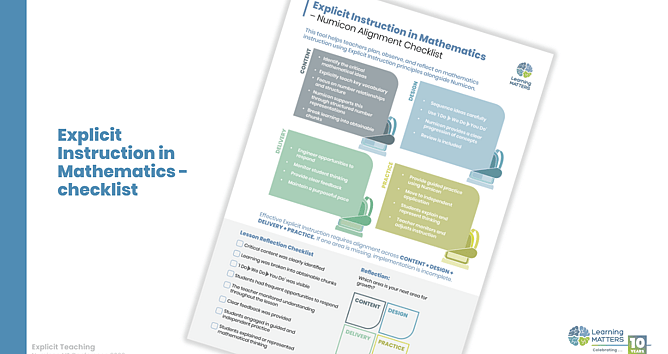
In my workshop, I focused on a central idea that sits at the heart of improving outcomes in mathematics: instruction matters. More specifically, how we design and deliver instruction shapes what students attend to, what they understand, what they remember, and what they can do. Drawing on Anita Archer’s 13 elements of Explicit Instruction, I explored how effective mathematics teaching rests on alignment across content, design, delivery, and practice.
A central theme was that explicit instruction is not a programme or script, but a framework for effective teaching. We explored how teachers can identify critical mathematical content, break learning into obtainable chunks, use I Do, We Do, You Do to structure success, and bring instruction to life through active participation, feedback, monitoring, and purposeful pace. I also shared the Explicit Instruction in Mathematics Numicon Alignment Checklist as a practical tool to support planning, observation, and reflection.
Key ideas explored in the workshop included:
Instructional alignment across content, design, delivery, and practice
Identifying critical content and breaking learning into obtainable chunks
Using I Do, We Do, You Do as a design for success
High leverage teaching practices that strengthen active participation
Opportunities to respond as a driver of learning
Monitoring, feedback, and purposeful pace in lesson delivery
Deliberate, spaced, interleaved, and retrieval practice
How Numicon lends itself to explicit instruction when used through a strong instructional lens
Keynote: Learning That Sticks, The Role of Memory in Mathematics Instruction
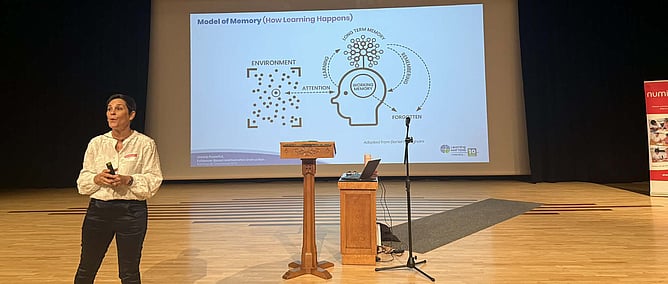
My keynote turned to a related question: if instruction matters, how does learning actually happen? This session explored the role of memory in mathematics learning and the implications this has for classroom practice. A central proposition was that when learning does not stick, the issue is often not effort or motivation. It is often memory. Using insights from cognitive science, including Daniel Willingham’s model of memory, I explored how working memory limitations, cognitive load, knowledge in long term memory, and retrieval all shape mathematics learning.
We explored why fluency matters, how practice builds memory, why retrieval strengthens learning, and how knowledge becomes usable through the shift from episodic memory to semantic memory. I also emphasised the importance of vocabulary as knowledge, and why explicit vocabulary instruction matters in mathematics as much as in literacy. The keynote closed with a simple but important idea: if learning is going to stick, we must teach for memory.
Key ideas explored in the keynote included:
Why learning that does not stick is often a memory issue
Working memory, cognitive load, and implications for instruction
Fluency as accuracy, rate, and retention
Four forms of practice that build memory
Retrieval practice as a mechanism for strengthening learning
How knowledge moves from episodic memory to semantic memory
Why variation matters in building transferable knowledge
Vocabulary as knowledge and the role of explicit vocabulary instruction
Teaching for memory as a core design principle for mathematics instruction
Where to Next?
It was also apparent in conversations throughout the conference that there is more work to do to build a shared understanding of the difference, and the connection, between the science of learning and the science of instruction. These are related, but they are not the same. Understanding both matters if we are serious about strengthening practice.
How well we teach shapes how well students learn.
Instruction remains the through road.
Not as a slogan, but as a practical reality.
The decisions teachers make every day about content, explanations, examples, questioning, feedback, practice, and pacing matter deeply. They shape attention. They shape memory. They shape understanding. And ultimately, they shape outcomes.
That is both the responsibility and the privilege of teaching.
My hope is that this prompts reflection on one simple question:
What might be your next step in strengthening your practice?
It may be refining how you break learning into obtainable chunks.
It may be increasing opportunities to respond.
It may be revisiting the role of retrieval practice.
It may be sharpening lesson design through stronger alignment across content, design, delivery, and practice.
Or it may be taking a deeper look at how explicit instruction can support more consistent, effective teaching across your classroom, team, or school.
Improvement does not require changing everything at once.
Often it begins by improving one thing well.
One routine. One practice. One stronger instructional decision.
And then building from there.
If these ideas resonate, and you would like to explore how to strengthen efficient and effective instruction in a practical, evidence-informed way, I would love you to join us at one of our upcoming Efficient and Effective Instruction workshops, focused on embedding explicit instruction for more consistent schoolwide practice.
These workshops are designed for educators and leaders wanting practical next steps, stronger shared practice, and greater coherence in instruction.
You can learn more here:
https://bit.ly/ExplicitInstructionWorkshop
Because teaching matters.
And when we strengthen instruction, we strengthen what is possible for learners.