As we enter our tenth year of Learning MATTERS, it is both exciting and grounding to look back and see how far we have come. A decade ago, much of our work was about developing awareness, translating the research into practice, building community, and advocating for an evidence-based system. Essentially, our work was centred on cultivating the literacy landscape. We were focused on challenging ineffective practices and helping schools reorient around structured literacy and explicit instruction.
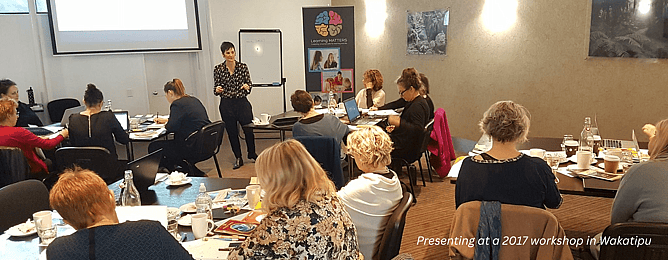
Presenting at a 2017 workshop in Wakatipu
Now the work ahead is different.
It is about deepening knowledge.
It is about refining practice.
It is about ensuring the change is longstanding.
It is about ensuring educators across Aotearoa New Zealand understand what Dr Anita Archer has long reminded us — good teaching is good teaching irrespective of content, skills, ages and stages.
I recently sat down to have a conversation with our upcoming symposium speakers Brendan Lee, Sarah Brown and Steve Capp. We talked about classrooms, leadership, behaviour, intervention, implementation, and what it really takes to shift outcomes in schools. Across very different contexts and careers, one idea kept resurfacing.
Learning is Learning.
Connecting with like minds who care deeply about this work is always energising. So I wanted to share six insights from our conversation. I hope they’re useful in your own implementation discussions and that they spark thinking because, as we all know, what we focus on expands.

2026 Learning is Learning Symposium Keynote Speakers
1. Stop treating learning as different depending on the subject
Our discussions reinforced something that should be obvious yet is often missed. If someone tells you learning maths is fundamentally different from learning to read, a red flag should go up. The content differs, but the principles of learning do not.
Learning still relies on the Science of Learning and the Science of Instruction:
Clear explanation and modelling
Cumulative knowledge building through clear lesson sequences and gradual release of responsibility
Guided practice with feedback that builds accuracy and fluency
Checks for understanding that inform next steps.
A well-structured maths lesson and a well-structured reading lesson will look different in content but similar in architecture. That’ s not a coincidence. It should be the case because we now know how learning works.
Practical Reflection:
When planning a lesson ask yourself whether you have planned the learning sequence or simply the activity.
2. Use the simplest rule you can especially under pressure
Teachers are often trying to hold dozens of strategies in their heads while teaching. That cognitive load is real.
One recommendation was to simplify decision making during instruction.
For instance:
If students are confused during I do, model it again.
If We do is not successful, return to I do.
If We do is secure, move to You do.
If independent practice breaks down, go back to guided practice.
This reduces decision fatigue and creates clarity.
Clarity reduces stress. Clarity strengthens responsiveness. Clarity improves teaching.
Practical Reflection:
What are the simple rules you can rely on when things wobble?
3. Replace destructive struggle with productive support
We spoke honestly about what sometimes gets labelled productive struggle.
Too often, students are placed into tasks they do not yet have the knowledge to complete, and we call the resulting confusion resilience building.
In reality, it can become destructive struggle.
You see it in classrooms.
Papers ripped up.
Students shutting down.
Escalating behaviour.
Teachers stepping in to rescue.
That is not a character flaw in students. It is often a mismatch between task demands and prerequisite knowledge.
Practical Reflection:
Before setting a task, ask what students must already know to succeed. If the answer is a lot, then the next move is not more struggle. It is clearer modelling, tighter scaffolding and deliberate guided practice.
4. Data shapes perspective and perspective shapes action
During our discussion it was stated that “the perspective we take determines the next actions we take”.
Most teams look at data and immediately zoom in on individual students. That is important. But if 42 percent of a cohort are below benchmark, that is not only an intervention issue. It is a Universal Tier 1 instruction issue.
Practical Reflection:
Are you building data conversations that ask:
How many students have this need?
What does this suggest about Tier 1 instruction?
Who is getting stronger results and what are they doing?
What is the smallest change that could move the largest group?
5. Multi-Tiered Systems of Support MTSS is not a template it is a response
MTSS language is growing in Aotearoa, New Zealand and that is exciting. But it must not become a rigid checklist.
Universal Tier 1, Targeted Tier 2 and Tailored Tier 3 are not boxes to tick or groups to assign. They are responses to real data.
In some contexts, strengthening Tier 1 will have the greatest impact. In others, intensive support must be prioritised while foundational instruction is rebuilt.
Different schools. Different starting points. Different data pictures. These should look different from school to school.
Practical Reflection:
Do you have an MTSS structure and systems of support in place? Is your MTSS structure responsive to your data or simply inherited from a diagram?
6. Implementation takes longer than people want it to
We spoke about impatience.
A common complaint we hear is “we have been doing this for a year, and the data has not shifted”.
This is one of the most common leadership tensions in school improvement.
Sustainable change requires building teacher knowledge, refining routines, aligning resources, supporting middle leaders and staying the course.
Short-term data may fluctuate while practice stabilises. That does not necessarily mean the strategy is failing. It may mean the system is still embedding it.
Strong implementation requires courage, clarity and consistency over a long period of time.
Practical Reflection:
Are you evaluating impact too quickly or avoiding accountability altogether?
Why this matters now
As we enter our second decade at Learning MATTERS, while the work ahead is still about awareness and advocacy, it is now even more about precision, persistence and proactive planning. It is about ensuring that within our schools across Aotearoa New Zealand:
Explicit instruction is understood deeply not superficially.
MTSS is used thoughtfully not mechanically.
Data informs perspective.
Leaders create environments where teachers can teach well.
Behaviour and wellbeing are strengthened through clarity and success.
Learning is Learning.
2026 Learning is Learning Symposium
We are excited to announce that tickets for our 2026 Symposium have just gone on sale.
We look forward to bringing educators together with leading experts for a powerful day that builds on the work already underway and supports confident, informed decisions about instruction, systems, and leadership.