
Part 2 of 3 | It's Not Either/Or. It's Knowing When.
One of the highlights of the Learning is Learning Symposium was hearing from Brendan Lee, whose keynote challenged us to rethink one of the longest-running debates in education.
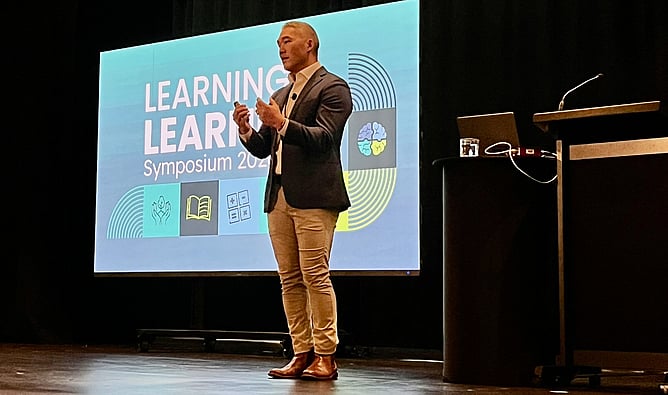
Should we teach explicitly?
Or should learning be inquiry-based?
His response was both simple and thought-provoking.
"It shouldn't be an either/or. It's more about understanding when to do what and why."
For many years, educational conversations have centred on which approach is "best". Brendan encouraged us to move beyond that debate by asking a far more useful question.
Where is the learner in relation to the Instructional Hierarchy?
That question changes the conversation because the answer should guide our instructional decisions.
One of the most valuable frameworks Brendan shared was the Instructional Hierarchy.
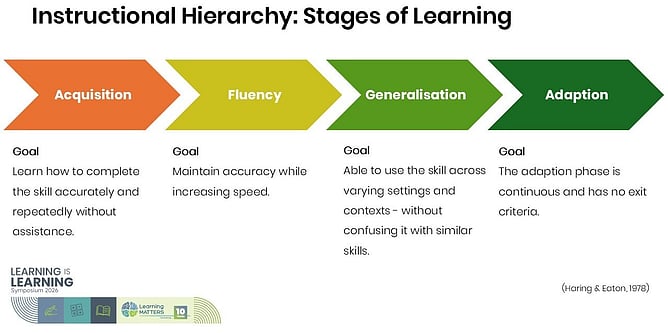
The Instructional Hierarchy reminds us that learning is developmental. Learners move through stages as they acquire new knowledge and skills, build fluency, begin transferring their learning into new situations and, ultimately, adapt their knowledge to solve increasingly complex problems.
Brendan didn't present the hierarchy simply as a way of understanding learning. He presented it as a way of making better instructional decisions.
When learners are in the acquisition phase, they are building new knowledge and skills. At this stage, they benefit from explicit teaching, clear explanations, careful modelling and guided practice. As learners move into fluency, those explicit approaches continue to play an important role while increasing opportunities for purposeful practice, retrieval and feedback help learning become increasingly accurate and automatic.
As learners progress into generalisation, the nature of instruction begins to change. They need opportunities to apply what they know in different contexts, make connections between ideas and solve increasingly complex problems. By the time learners reach adaptation, they have developed sufficient knowledge and skill to think more independently, investigate, inquire and discover. Rich, open-ended learning experiences become appropriate because they are built on a strong foundation of knowledge and understanding.
This is why the explicit versus inquiry debate misses the point.
The Instructional Hierarchy reminds us that explicit instruction and inquiry are not competing approaches. They each have an important place within the learning process. The expertise of teaching lies in knowing when to use each approach so that instruction matches where learners are in their learning.
There was another important message embedded within Brendan's keynote that I think deserves our attention.
Too often, we celebrate when learners can demonstrate a new skill once or successfully complete a task during guided practice. While those moments are encouraging, they represent the beginning of learning rather than its destination.
Our goal is not simply acquisition.
Our goal is to deliberately move learners towards fluency, where learning becomes increasingly automatic; towards generalisation, where they confidently apply their knowledge in new contexts; and ultimately towards adaptation, where they use their knowledge flexibly, independently and creatively.
That progression doesn't happen because time passes. It happens because teachers intentionally create opportunities for learners to practise, retrieve, apply and extend their learning over time.
The Instructional Hierarchy also provides a valuable lens for thinking about differentiation.
Rather than beginning by asking how we can create different activities for different learners, perhaps we should first ask where each learner sits within the learning process. Learners in the acquisition phase are likely to require greater scaffolding, explicit modelling and guided practice. Learners developing fluency need repeated opportunities to retrieve and consolidate their learning. Those moving into generalisation and adaptation require increasingly rich opportunities to transfer, apply and extend their thinking in authentic contexts.
The same thinking applies to extension.
Extension isn't about providing more work or simply making tasks harder. Meaningful extension deliberately moves learners into generalisation and adaptation. It asks them to apply their learning in unfamiliar situations, make connections across ideas, justify their thinking and solve authentic problems using the knowledge and skills they have developed.
Perhaps one of the most powerful insights from Brendan's keynote is that the Instructional Hierarchy doesn't only apply to our students.
It applies to us as educators as well.
Every significant professional learning journey begins with acquisition. We need clear explanations, modelling and opportunities to practise. As our confidence grows, we become increasingly fluent before transferring our learning into different classrooms, different contexts and, eventually, adapting it to meet the needs of the learners we teach.
As you begin planning for the months ahead, perhaps these are the questions worth exploring with your team.
1. Where are our learners within the Instructional Hierarchy?
2. Are our instructional decisions helping them move to the next stage of learning?
3. Are we differentiating and extending learning based on where learners are in their learning journey, rather than simply providing different activities?
These questions encourage us to think differently about planning, teaching and assessment. More importantly, they remind us that every instructional decision should be grounded in a clear understanding of how learning develops.