Last week at Harvard, I had the privilege of hearing from and meeting Rwanda’s Minister of State for Education, Hon. Claudette Irere.
As I listened to her speak so openly about the challenges of leading change across Rwanda’s education system, I found myself thinking constantly about what is happening at home in New Zealand.
We are in the midst of significant change in education. In literacy particularly, we have seen a substantial shift in what we expect to be taught, the evidence informing those expectations, and the knowledge and practice required of teachers. Having been closely involved in this change over many years, I know that agreeing on what needs to change is only part of the work. The much harder question is how we enable that change to happen, consistently, across thousands of classrooms.
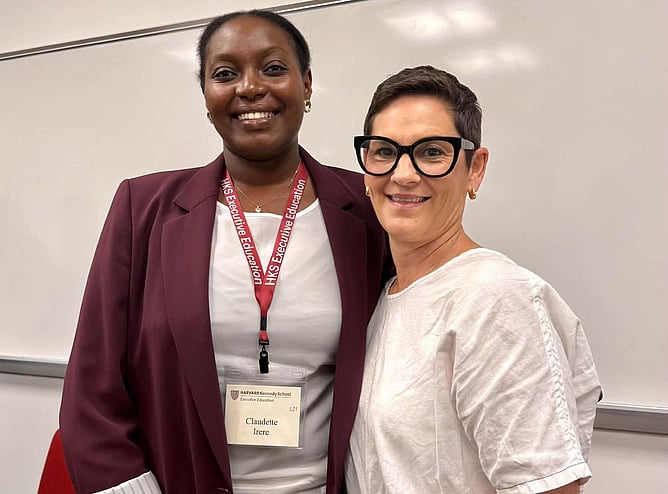
Minister Irere spoke candidly about the gap that can exist between the vision at the centre of a system and what ultimately happens for a child in a classroom. Different country, very different context, but that challenge sounded remarkably familiar.
Again and again, she came back to teachers. Her message was clear. If Rwanda wants to improve learning, including strengthening literacy and responding to the challenges of teaching and learning in English, then building teacher knowledge and capability has to be central to the work.
That really resonated with me.
Our experience in New Zealand is reinforcing something similar. Changing a curriculum does not, by itself, change teaching, nor does it automatically improve outcomes. Neither does publishing new resources or providing professional learning. Teachers and leaders need opportunities to build knowledge, practise, receive feedback, solve the inevitable problems that arise, and be supported to turn new expectations into everyday classroom practice.
The challenge is not simply designing the change. It is creating the conditions that enable people across a system to make that change real.
Perhaps that was my biggest takeaway from the conversation. You can travel halfway around the world, listen to an Education Minister from Rwanda and find yourself thinking, gosh, we are grappling with some of the very same things in New Zealand.
And that is why these global conversations matter.
Our contexts, histories and education systems may be very different, but there is much we can learn from one another. We can share what is working, be equally open about what is not, and support one another as we tackle the difficult work of turning policy and evidence into better teaching and better outcomes for learners. We do not need to figure all of this out in isolation.
Thank you, Minister Irere, for such an open and thought-provoking conversation. I came away reminded of the value of looking beyond our own borders, not to find someone else’s answer, but to learn from different experiences, ask better questions and perhaps share a little of what we have learned along the way too.
And who knows where a conversation might lead? That is one of the things I am really enjoying about Learning Out Loud from a little further away from home.