Part One
| Reflections from The Reading League Conference 2026
Imagine learning to play tennis by spending most of your training session watching the coach. The coach explains the serve beautifully, models the grip and shows you where to place your feet. You understand what to do and, when it is finally your turn, you might even execute a pretty good serve.
But none of us would expect to become a tennis player that way. At some point, we must hit the ball. We need opportunities to practice, make mistakes, receive feedback, adjust and try again. Over time, something that initially required enormous concentration becomes more efficient and increasingly automatic.
We understand this intuitively when learning almost any complex skill, and it is one reason Carolyn Brown and Carolyn Strom's presentation, Beyond "I Do, We Do": The Power of Rich and Varied Practice, was one of my favourite presentations at The Reading League Conference 2026. Their work made me think more deeply about the role practice plays in learning to read and, importantly, what effective practice looks like.
It feels particularly relevant right now. Teachers have worked incredibly hard to strengthen explicit and systematic literacy instruction, building knowledge, learning new approaches and routines, responding to curriculum change and, in many schools, shifting towards more whole-class teaching. There is much to feel positive about in that work. Brown and Strom's presentation prompted me to think about what an important next area for us might be to pay attention to.
As we strengthen the teaching, are we also protecting enough time for every learner to practice? And when they do practice, is that practice designed and pitched in a way that moves their learning forward?
Instruction and practice play different roles in learning
One of the most useful distinctions Brown and Strom made was between explicit instruction and student practice. Explicit instruction is teacher-directed and is particularly important when learners are novices because it allows us to introduce new knowledge, direct attention to what matters, explain, model and provide support.
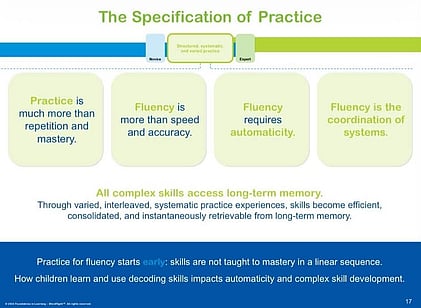
Practice plays a different, but complementary, role. It gives learners opportunities to work with that knowledge by retrieving it, discriminating between alternatives, connecting it with previous learning, applying it under different conditions, making errors, responding to feedback and gradually becoming more efficient in using it. Brown and Strom position structured, systematic and varied practice as an important part of the journey from novice performance towards increasingly automatic and fluent performance.
This distinction matters because successful performance during instruction does not necessarily mean that learning is yet secure or flexible. A child may accurately decode something they have just been taught, but skilled reading requires them to retain that learning, retrieve it when they need it and apply it to new words and connected text, while bringing together the many other processes involved in reading.
Importantly, Brown and Strom do not suggest that children first receive explicit instruction, master a skill and only then begin to practice it. Instead, practice begins alongside instruction and continues as children strengthen, connect and increasingly automate what they are learning. As one of their slides puts it, “Practice for fluency starts early. Skills are not taught to mastery in a linear sequence.”
For me, this is a helpful way of thinking about the relationship between teaching and learning. We can become increasingly precise about what we teach and how we explain it, while recognising that learners also need enough opportunities to work with that knowledge for it to become increasingly secure, connected and available for use.
We need precision in what we teach, alongside richness in the opportunities children have to use it. Not all practice is the same.
Brown and Strom were not simply making an argument for more practice. Their focus was also on the characteristics of practice that support learning. Their ACTIVE framework brings together Appropriate Difficulty, Contrasts, Targeted Feedback, Interleaving, Varying the Tasks, and Elaborating, Reviewing and Rehearsing, with activating prior knowledge at its centre.
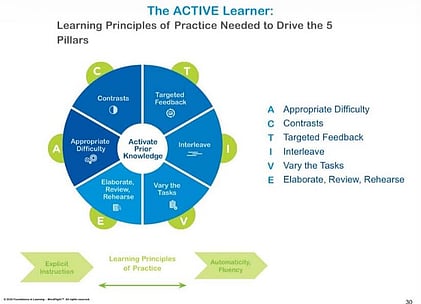
What I found particularly useful is that these aren't simply ways of making practice more interesting. They change the cognitive work the learner is doing. Bringing previous learning back requires retrieval. Contrasting patterns requires learners to notice what is different. Varying the task asks them to use what they know under different conditions, while feedback helps them notice, adjust and try again.
The principle of appropriate difficulty particularly caught my attention. More practice is not necessarily better practice if the task is already effortless for one learner and inaccessible to another. Effective practice needs to ask something of the learner, with enough challenge to require retrieval and thinking, alongside enough knowledge and support for them to experience success.
This becomes particularly interesting in a whole-class setting. We can teach important content explicitly to everyone while still considering what happens when students move into practice. Who needs more opportunities? Who needs previously taught material brought back? Who needs greater contrast between patterns, and who is ready for more variation?
So perhaps the question isn't simply, Did my students practice? It is also: How much opportunity did each learner have to practice, what were they being asked to do with their knowledge, and was the level of challenge right for them?
Brown and Strom captured the idea of varied practice simply: “Mix it up, mix up the content, mix up the task.” This doesn't mean making practice random or creating an endless supply of new activities. Instead, variation can be deliberate and carefully designed so that learners have opportunities to retrieve, discriminate, connect and apply previously taught knowledge.
What might this look like tomorrow?
This was one of my favourite parts of the presentation. Carolyn Strom showed that applying these principles doesn't necessarily require elaborate new activities. Sometimes a small change to familiar practice can change the thinking required of the learner.
Imagine that today's teaching focus is a new vowel pattern. Rather than practising only words containing that pattern, bring back words containing patterns taught last week or last month. Now children can't assume they know what every word will contain. They must look, discriminate and retrieve what they know. It is a small shift in the task, but a meaningful shift in the thinking.
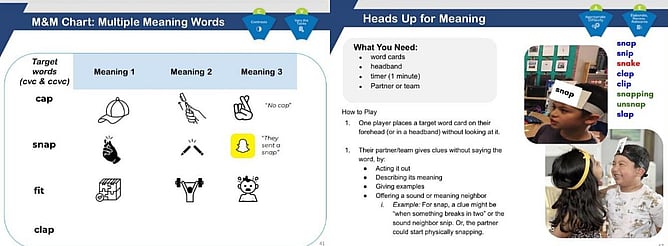
Strom also demonstrated that varying the task doesn't necessarily mean changing the content. Her Heads Up for Meaning routine uses words children have already encountered but asks them to retrieve and use those words differently by describing, acting out or giving clues while a partner identifies the word. The knowledge is familiar, but the learner is accessing and using it in another way.
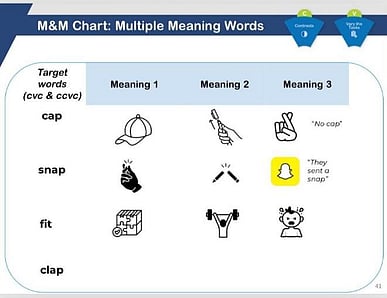
Her M&M, or Multiple Meanings, routine makes another important connection. A word children are learning to decode can also become an opportunity to explore language and meaning. Fit, for example, might describe shoes that fit, someone throwing a fit, or someone's outfit. In a simple exchange, word reading begins to connect with oral language, vocabulary and meaning.
Across these examples, the activity itself is perhaps less important than the principle underneath it. When previous learning comes back, patterns are contrasted, tasks vary and feedback helps children adjust, learners must pay attention, retrieve what they know and make decisions about how to use it. That difference in the cognitive work is why the design of practice matters.
So where does practice live in our literacy blocks?
This brings me back to the question I have been thinking about for classrooms. As we have strengthened explicit instruction and, in many settings, moved towards more whole-class teaching, have we protected enough time for every child to practice?
This isn't an argument for returning to literacy rotations, nor is it a criticism of whole-class teaching. It is simply an invitation to notice, as classroom structures change, where the opportunities for students to practice now sit.
Because the amount of teaching taking place in a classroom and the amount of practice experienced by an individual learner are not necessarily the same thing.
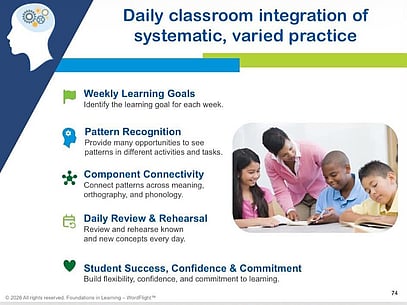
Perhaps there is a simple place to start. Take ten minutes of your literacy block and look at it through the eyes of one learner. How much of that time are they reading, writing, retrieving, comparing or applying? How many opportunities do they have to respond and receive feedback? Does previous learning reappear? And is the practice at an appropriate level of difficulty for that learner?
Then perhaps look for one small opportunity to strengthen the practice. Bring back something taught last week. Mix previously taught patterns with today's learning. Give students another opportunity to respond after feedback. Vary the way they use familiar knowledge. Or simply create a little more time in which every learner, rather than the teacher, is doing the work.
This isn't about adding another programme, routine or expectation to an already busy literacy block. Teachers have done an extraordinary amount of work to strengthen literacy instruction, and there is much to feel positive about as that work continues to develop. Perhaps the next opportunity is simply to become as curious about the practice as we have become about the teaching.
Alongside asking What are we teaching, and how explicitly are we teaching it? We might also ask:
How much opportunity does each learner have to practice what we have taught, and is that practice at the right level to move their learning forward?
Excellent instruction and excellent practice are partners. What ultimately matters is not simply that children have been taught, but that they have enough carefully designed opportunities to turn that teaching into learning they can retrieve, connect, generalise and use.
For me, that was the lasting message from this session. We need precision in what we teach, and richness in the opportunities children must use it.
A huge thank you to Carolyn Brown and Carolyn Strom for sharing their work so generously at The Reading League Conference. Their presentation has certainly made me look more closely at practice, not simply as something that happens around instruction, but as a critical part of how learning happens. Slide images inserted with permission of authors, Carolyn Brown and Carolyn Strom.