
Part Two
| Reflections from The Reading League Conference 2026
In Part One of my reflections from The Reading League Conference, I wrote about practice: how much opportunity our learners have to practice, and whether that practice is designed to move their learning forward.
Another presentation that stayed with me took that thinking one step further. How do we build the kind of instruction and practice we know matters into the everyday routines of our classrooms?
It was particularly lovely to see Dr Sarah Brown presenting. Many of you will remember Sarah joining us in New Zealand for the Learning is Learning Symposium earlier this year, where she challenged us to think carefully about the importance of strong Tier 1 instruction. At The Reading League Conference, Sarah presented alongside Dr Stephanie Stollar, Dr Kelly A. Powell-Smith and Beth A. Madden, the team behind the newly released Routines for Reading Results.
Their presentation, Teaching for Results: Using High-Impact Instructional Routines for Early Reading Success, left me thinking about a word that can sometimes get a mixed reaction in education: routine.

What if predictability is a good thing?
As teachers, we can feel pressure to keep creating something new. New activities, new resources, new ways to keep students engaged. A routine can sound repetitive, perhaps even a little boring.
Brown made a point that I loved: what feels repetitive to us can bring clarity to learners.
When the structure of a task is familiar, children don't have to spend as much cognitive energy working out what they are supposed to do. They know the routine, so more of their attention can go to the learning itself.
Importantly, the presenters weren't talking only about intervention. Effective instructional routines can support teaching and learning across Tier 1, Tier 2 and Tier 3. Strong instruction accelerates learning for everyone.
That took me straight back to Sarah's message in New Zealand. If we want fewer learners to require increasingly intensive intervention, then what happens every day in Tier 1 really matters.
But what about teacher judgement?
This is where the presentation became particularly interesting because the team moved from routines to another word that can provoke an even stronger response: scripts.
A script can sound like the opposite of expert teaching. If we give teachers the words and sequence, are we reducing professional judgement?
Their argument was almost the reverse.
A well-designed script allows us to decide before the lesson the things that can be decided in advance: concise teacher language, the instructional sequence, the model and the prompts. This leaves more attention during the lesson for the decisions that really do require teacher expertise.
Is this learner responding accurately? Do I need to model again? Does the group need another opportunity to practice? What kind of error am I seeing? Are they ready to move on?
Those decisions can't be scripted in advance because they depend on the learners in front of us.
I found this a useful way to think about routines. Consistency doesn't have to mean rigidity. In fact, a strong routine can create more space for teachers to notice, respond and adapt.
Accuracy isn't the finish line
This led to another important idea from the presentation. Brown asked the audience to repeat a deceptively simple statement:
“Accuracy isn't mastery.”
A learner might produce the correct response during today's lesson, but that doesn't necessarily mean the knowledge is secure, automatic or available for use tomorrow.
The presenters explained that our instruction should shift as learners move from acquiring something accurately towards using it increasingly automatically. When knowledge is new, learners may need more modelling and support. As they become accurate, the balance begins to shift. They need more opportunities to respond, retrieve and practice for themselves.
Their analogy was learning to drive. Once a teenager knows what to do, watching us drive for another 20 hours isn't going to make them a fluent driver. Eventually, they have to drive.
This connects beautifully with my reflection in Part One. Explicit instruction matters enormously, but learners also need to do the cognitive work that helps what has been taught become increasingly automatic and available for use.
How many opportunities do learners have to respond?
One practical routine the team explored was choral responding, where all learners respond together when there is one correct answer.
What interested me wasn't simply the technique. It was the principle underneath it: opportunities to respond.
If I ask a question and one child answers, one child has had an opportunity to retrieve and produce the answer. Structure that interaction so every learner responds, and suddenly many more children are actively practising within exactly the same instructional time.
Of course, a group response doesn't tell us that every learner can do it independently. The presenters emphasised careful monitoring, immediate correction and individual turns to check that learning is secure.
This is where the routine and teacher expertise come together. The routine creates the opportunity to respond. The teacher watches, listens and decides what needs to happen next.
What happens when an error occurs?
This was another part of the presentation I appreciated. Errors weren't treated as something to leave until later. The presenters described immediate, calm and supportive correction: provide the correct response, support the learner if needed, have them respond correctly, then come back to it again.
One example was wonderfully simple. If a child continues to have difficulty with a particular sound or word, put it on a sticky note with several others and place it on the corner of their desk. Later in the day, stop by and ask them to read a row. Then come back again.
No elaborate new resource. Just another carefully timed opportunity to retrieve the learning successfully.
It is a small example, but I think it represents an important shift in thinking. Rather than stopping at Have I taught it? Let’s ask, what does this student need next to secure it?
Perhaps start with one routine
The newly released Routines for Reading Results takes this thinking much further, with routines spanning word recognition, vocabulary, morphology, syntax and comprehension.
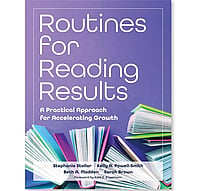
But I don't think the takeaway from this presentation is that teachers now need a collection of new routines. A more useful starting point might be to look closely at one routine already happening in your classroom.
How much teacher language does it require? Is that language as precise as it could be? How many opportunities does every learner have to respond? What happens when someone makes an error? How do you know everyone can do it, rather than most of the group? And once learners are accurate, does the routine shift so that they are doing more of the work?
Perhaps choose just one routine and watch it closely this week. Not to replace it, but to notice it. Where could you tighten the teacher language, increase opportunities to respond, improve the feedback or create another opportunity for a learner to retrieve something they have already been taught?
That feels manageable, and importantly, it builds on the expertise and practice already sitting within our classrooms.
For me, that was the lasting message from this presentation. Strong routines don't make teaching mechanical. Done well, they make the predictable parts of instruction more efficient, leaving teachers with more attention for the wonderfully unpredictable part: the learners in front of them.
It also brought me back to Sarah's message when she joined us in New Zealand. Strengthening Tier 1 isn't necessarily about finding the next programme, activity or initiative. Sometimes it is about looking closely at the instruction learners already experience every day and asking how we can make it even stronger.
Sometimes the opportunity is to get even better at the important things we do every day.
My thanks to Sarah Brown, Stephanie Stollar, Kelly A. Powell-Smith and Beth A. Madden for such a practical and thought-provoking session, and congratulations on the release of Routines for Reading Results. I suspect this is one I am going to be returning to often.


