Part 3 of 3 | The Conditions We Create Matter Most
Leadership has never been more complex.
Schools are navigating significant curriculum change, new assessment expectations and an ever-growing number of competing priorities. It can sometimes feel as though the list of things outside our control continues to grow.
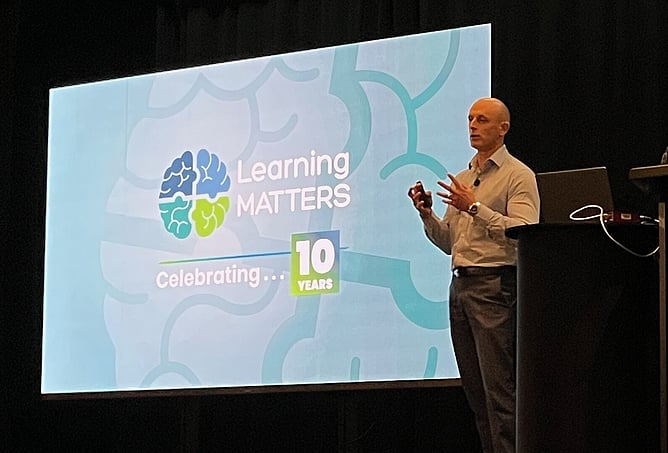
During our Learning is Learning Symposium, Rhys Coulson offered a timely reminder that has stayed with me.
"You are the author of the rhythm of your school. You dictate the rhythm and the weather of your school. These are the conditions that you can control."
I think that is one of the most important leadership messages we can hold onto right now.
While we cannot control every policy decision, curriculum update or external expectation, we can control the conditions we create for teachers and learners every day.
Throughout his keynote, Rhys challenged us to think less about programmes and more about leadership. Schools rarely improve because of one professional learning day or one new initiative. They improve because leaders are intentional about how they use time, where they focus attention and what they consistently prioritise.
One of the strongest messages I took away from Rhys' keynote was that leaders need to lead the learning.
Professional learning providers, consultants and instructional coaches all play an important role in building knowledge and capability. They bring expertise, challenge our thinking and support schools on their improvement journey. However, they cannot replace the role of school leaders.
Instructional leadership cannot be subcontracted.
Leaders create the conditions where professional learning becomes professional practice. They participate in the learning, ask thoughtful questions, visit classrooms, observe practice, provide feedback and maintain focus long after the external support has finished. They understand that culture is shaped by what leaders consistently pay attention to.
Rhys also challenged us to think differently about one of the most valuable resources in any school: teachers' time.
Every meeting should have a clear purpose. If information can be communicated effectively in an email, it doesn't belong in a meeting. Face-to-face time is simply too valuable to spend sharing information that people could have read beforehand.
Instead, meetings should move learning forward.
They should be opportunities for teachers to examine practice, solve problems collaboratively, deepen professional knowledge and strengthen implementation. Every meeting should leave teachers clearer, more confident or better equipped than when they arrived because every interaction either strengthens or weakens the conditions we are trying to create.
One example that particularly resonated with me was the way Rhys described Intellectual Preparation Time.
These sessions are intentionally planned. Before introducing new professional learning, leaders deliberately revisit previous learning. Teachers review key concepts, retrieve prior knowledge, discuss how ideas are being implemented in classrooms and clarify misunderstandings before building on them.
It is a simple leadership practice, but one grounded in what we know about learning.
Teachers need review and retrieval opportunities too.
We would never expect students to retain new learning without deliberately revisiting it over time. We know retrieval strengthens memory, deepens understanding and supports long-term learning. The same is true for adults. Professional learning becomes embedded not because we attended a workshop, but because leaders intentionally create opportunities to retrieve, revisit, practise and refine learning over time.
This connected beautifully with Brendan Lee's keynote.
Just as learners move through the Instructional Hierarchy from acquisition to fluency, generalisation and adaptation, teachers also need opportunities to move through those same stages in their own professional learning. They need time to practise new approaches, receive feedback, reflect on their implementation and continue refining their practice until new learning becomes part of what they do every day.
Creating those opportunities requires discipline.
It means protecting teachers' cognitive load by focusing on the vital few priorities rather than continually introducing something new. It means giving people time to become increasingly expert instead of expecting immediate mastery. It means recognising that sustainable improvement is built through deliberate attention over time, not through isolated moments of inspiration.
As I reflected on Rhys' keynote, I found myself considering a different set of leadership questions.
1. Are we using teachers' time as intentionally as we expect them to use students' time?
2. Do our meetings strengthen professional practice, or simply communicate information?
3. Are we deliberately building review and retrieval into professional learning, or are we continually moving on to the next new idea?
4. Are we creating the conditions where teachers can confidently embed new learning?
These are important questions because leadership is not simply about responding to change. It is about creating the conditions where improvement can flourish despite the change happening around us.
Thank you to Rhys for reminding us that our greatest influence as leaders is not found in trying to control everything. It is found in intentionally shaping the conditions that matter most.
Perhaps that is the opportunity before all of us.
We may not be control every change taking place across education, but we can control the weather inside our schools. When we intentionally create the right conditions for teachers to learn, collaborate and continually improve, we create the conditions for every learner to thrive.